Debt Snowball vs. Debt Avalanche: Which Debt Should You Pay First?
You open two credit card statements. One balance is $600. The other is $2,400, and its interest rate is twice as high. You have $150 left after covering your required payments. Which card gets it?
The debt snowball sends it to the $600 balance. The debt avalanche sends it to the card with the higher rate. With either method, keep making the required payments on your other accounts. The choice is about where the extra goes.
If minimizing interest is your main goal, start by comparing the avalanche. If clearing a balance sooner would make the plan easier to stick with, compare the snowball too. The Consumer Financial Protection Bureau's debt worksheet explains both approaches and how to redirect payments once a debt is paid off.
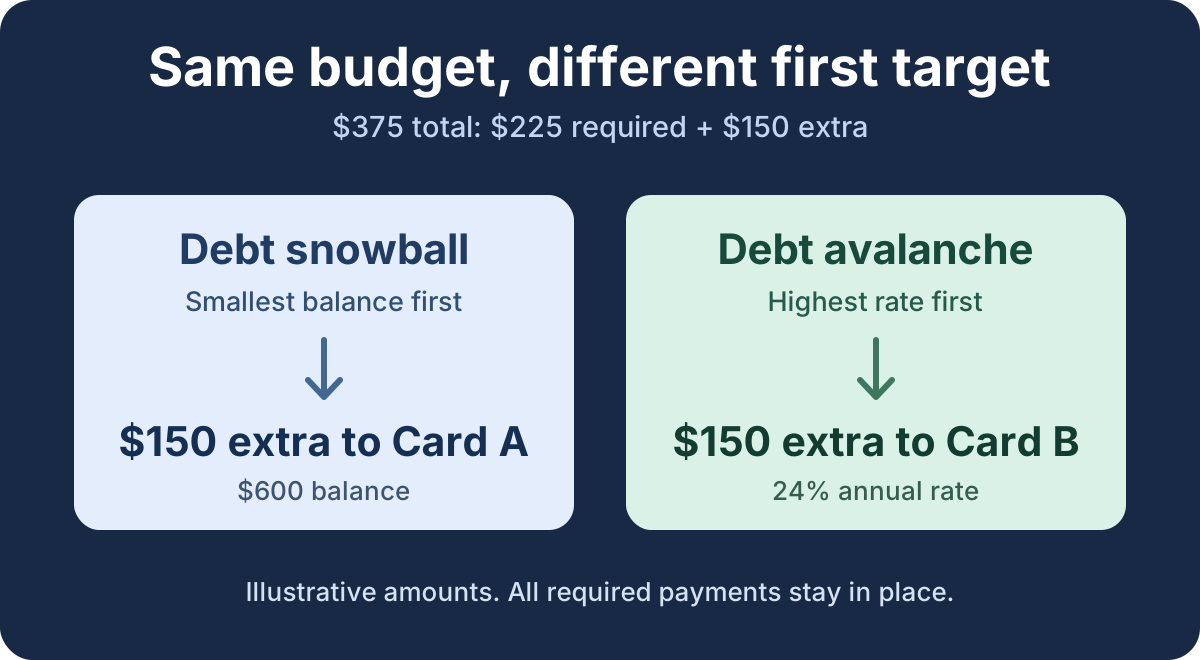
Put the same $375 to work two ways
Suppose your bills and essential expenses are covered, and you can afford $375 for debt payments this month. In this fictional example, required payments add up to $225, leaving $150 extra.
| Account | Balance | Annual rate | Required payment | Snowball payment | Avalanche payment |
|---|---|---|---|---|---|
| Card A | $600 | 12% | $30 | $180 | $30 |
| Card B | $2,400 | 24% | $75 | $75 | $225 |
| Loan C | $4,000 | 8% | $120 | $120 | $120 |
| Total | $225 | $375 | $375 |
With the snowball, Card A gets the extra because it has the smallest balance. With the avalanche, Card B gets it because it has the highest rate. If the smallest balance also has the highest rate, both methods start in the same place.
Why does the rate matter? In a simplified month, $150 outstanding at 24% annual interest costs about $3 in interest, compared with $1.50 at 12%. That gives you a feel for what changes when you put the extra money on the more expensive card. It isn't an estimate of total savings or the interest on either statement. Billing dates, daily accrual, fees and how the creditor applies payments can change the result.
Make sure there's actually money to send
A payoff order only helps after you've covered the required payments and essential expenses. Look at what's due before your next paycheck. A $150 extra payment on paper can be a problem if it leaves you putting groceries or a utility bill back on the card.
If you can't cover all the minimums, set the payoff comparison aside and deal with the shortfall first. The CFPB's guidance on credit card debt describes asking creditors about changes to due dates, payment amounts or interest rates and considering nonprofit credit counseling. Our guide to preparing for a minimum-payment conversation helps you gather the details for that call.
An overdue account, a collection notice, a court deadline, a debt secured by property or a promotion about to expire can change what needs attention first. Get qualified help if you're unsure about the consequences. This example is for comparing extra payments on accounts you can keep current.
Compare the cost and the first milestone
Pull the balances, annual rates, due dates and required payments from current statements. Note any promotional deadlines, fees and payment rules. Use the same monthly budget for both estimates. Otherwise, you may give one method credit for what was really a bigger payment.
Look at two results together: the estimated interest over the plan and when the first balance might reach zero. The first tells you what the order could cost. The second tells you when you'll see a milestone. If you choose the avalanche and the first target is large, track its balance each month so progress is still visible. If you choose the snowball, check what the higher-rate debt might cost while it waits.
Write down the assumptions, including whether rates change, new borrowing is excluded and minimums stay flat. A payoff calculator can help compare scenarios. Its date is an estimate under those assumptions, and your actual statements are the record to check against.
Decide where the payment goes after a payoff
Return to the snowball example. A few payments later, suppose the creditor confirms $80 will fully settle Card A on the date you plan to pay. You budgeted $180 for that account. If timing and account terms permit, put the $100 left over toward Card B. That month's allocation becomes $80 to Card A, $175 to Card B and $120 to Loan C, still $375 total.
The next month, once Card A is settled, the full $180 former allocation can move to Card B, assuming your budget and the other required payments are unchanged. Card B gets $255 and Loan C still gets $120. Notice what moved: the old $30 required payment as well as the $150 extra.
Check the payoff amount and the following statement rather than assuming a displayed zero settles every charge. If the amount you can afford changes, redo the allocation with the new budget. A workable plan can change with your month.
Pick one target for this month
Write three lines on a private worksheet: what you owe in required payments, what's left after those payments and essentials, and which account gets the extra. Add the reason in plain language: “Highest rate, so I want to reduce its interest,” or “Smallest balance, so I want a milestone sooner and I've checked the cost.”
Once the payment posts, compare the new balance with what you expected. If they differ, check for new interest, charges or a timing difference before changing the plan. The Debt Reduction Pro planning app can help you compare payoff scenarios if you want a worksheet to start from. Keep passwords and full account numbers out of any comparison.
The figures here illustrate payment choices. They don't predict your payoff date, credit score or interest savings.
. The sources provide general education and do not endorse the app.